A GAMIFICATION TWEAK [INTERMITTENT REWARDS II]
[Psychology for Educators]
As the saying goes: ‘If it works, don’t fix it!’. Imagine you have a game you have used countless times in class. It’s a very simple vocabulary revision quiz. You divide your class into two (or more) groups and then you read out the clues: ‘What do you call someone who is always on time?’ The first person to raise their hand and answer correctly scores two points for the group. It’s simple, it’s easy and it’s great fun. Why change anything?
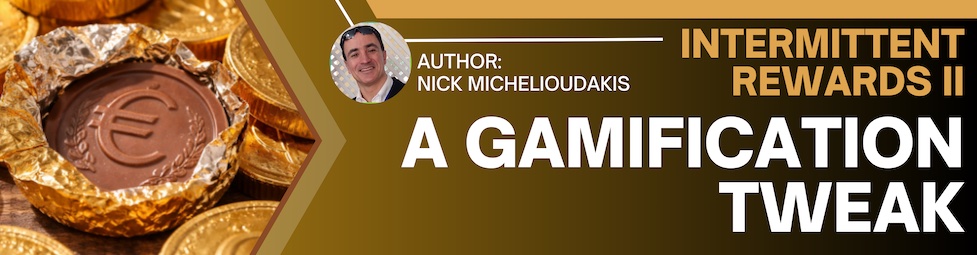
Now consider the following study (Shen et al., 2015). Researchers organised an auction in which people could bid for a lot which contained five chocolate coins. On average, the bidding went up to $ 1.25. They then organised another auction in which people could bid for a lot which contained either three or five chocolate coins (but the number was unknown). Incredibly, this time the average bid went up to $1.89!! OK – let me say this again: people were prepared to pay more for less (on average, the mystery lot contained four chocolate coins). Why?? The answer is that people were prepared to pay a certain amount for the chockies plus some more for the uncertainty! When it comes to rewards, uncertainty is motivating! ????
Consider a second study – one that involves students (Ozcelik et al., 2013). The latter were involved in a concept-learning game (gamification!). There were two conditions: in the first one, every correct response got a set number of points; in the second, the participants did not know how many points they had won – every time they got the right answer, the researcher rolled a die and the points awarded depended on the number that came up! What did the researchers found? You guessed it: students spent more time in the game and they were more accurate too. Fantastic! But what about us teachers? Do we make use of what the researchers have discovered? Of course not. '…only a few teaching games involve uncertain rewards, and, perhaps as a result, games are often no more effective than standard teaching programs.' (Wood 2019 – p. 125)
The take-away here is obvious. Take a leaf out of the researchers’ book: whenever you are playing a game with your class, don’t just award the same number of points for each correct answer. Just roll a die (you don’t even need to have one – just click here: https://freeonlinedice.com/). Quite apart from the excitement generated by the uncertainty, there is also the added advantage that even if a team happens to be weaker or way behind in points, they are still in with a chance because, well – dice are dice!
There is one last, more general point I want to make. Remember the original game? Yes, it is good and yes, it will work again next time – even in the simple form. But why not tweak it? Why not make it better? Here is the big take-away: ‘(Even) If it works – fix it!!’ ????
About the author
Nick Michelioudakis (B. Econ., Dip. RSA, MSc [TEFL]) has been active in ELT for many years as a teacher, examiner, presenter and teacher trainer. He has worked for a number of publishers and examination boards and he has given seminars in several countries. He has written extensively on Methodology, though he is better known for his ‘Psychology and ELT’ articles which have appeared in numerous newsletters and magazines.
He is a firm believer in the idea of revitalising ELT by importing ideas from such disciplines as Marketing, Management and Social Psychology as he feels that this is bound to lead to greater student motivation.
His areas of interest include Student Motivation, Learner Independence, Teaching one-to-one and Humour. He has his own YouTube channel (‘Comedy for ELT’) in which he often shares humourous clips along with worksheets for use in the classroom.
For articles or worksheets of his, you can visit his blog at www.michelioudakis.org.
[Read: W. Wood ‘Good Habits – Bad Habits’ – pp. 124-125]
Shen, L., Fishbach, A., & Hsee, C. K. (2015). The motivating-uncertainty effect: Uncertainty increases resource investment in the process of reward pursuit. Journal of Consumer Research, 41(5), 1301–1315.
Ozcelik, E., Cagiltay, N. E., & Ozcelik, N. S. (2013). The effect of uncertainty on learning in game-like environments. Computers & Education, 67, 12–20.